ChartVerse

Scaling Chart Reasoning via Reliable Programmatic Synthesis from Scratch

Zheng Liu1,3*, Honglin Lin2,3*, Chonghan Qin3, Xiaoyang Wang3, Xin Gao3, Yu Li3, Mengzhang Cai3
Yun Zhu3, Zhanping Zhong3, Qizhi Pei3, Zhuoshi Pan3, Xiaoran Shang3, Bin Cui1, Conghui He3,
Wentao Zhang1†, Lijun Wu3†

1Peking University    2Shanghai Jiao Tong University    3Shanghai AI Laboratory
*Equal contribution    Corresponding authors

Abstract

Chart reasoning is a critical capability for Vision Language Models (VLMs). However, the development of open-source models is severely hindered by the lack of high-quality training data. Existing datasets suffer from a dual challenge: synthetic charts are often simplistic and repetitive, while the associated QA pairs are prone to hallucinations and lack the reasoning depth required for complex tasks.

To bridge this gap, we propose ChartVerse, a scalable framework designed to synthesize complex charts and reliable reasoning data from scratch:

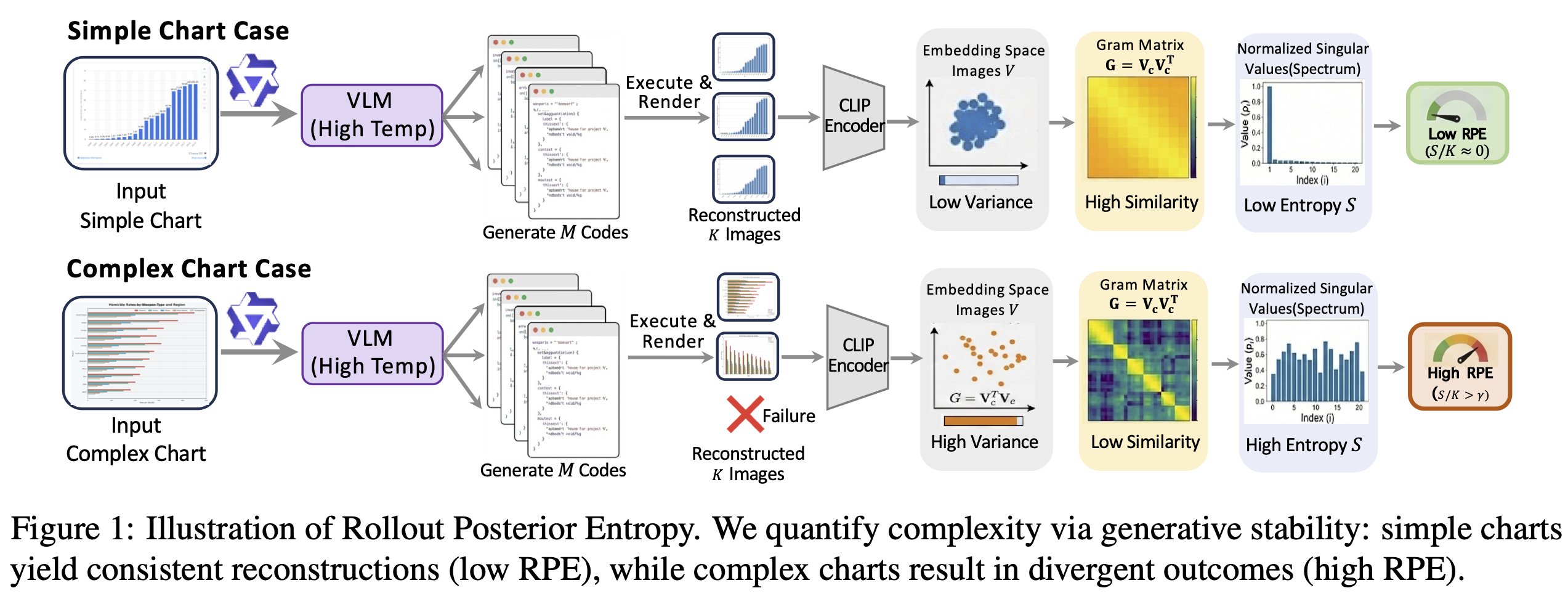
  • To address the bottleneck of simple patterns, we first introduce Rollout Posterior Entropy (RPE), a novel metric that quantifies chart complexity. Guided by RPE, we develop complexity-aware chart coder to autonomously synthesize diverse, high-complexity charts via executable programs.
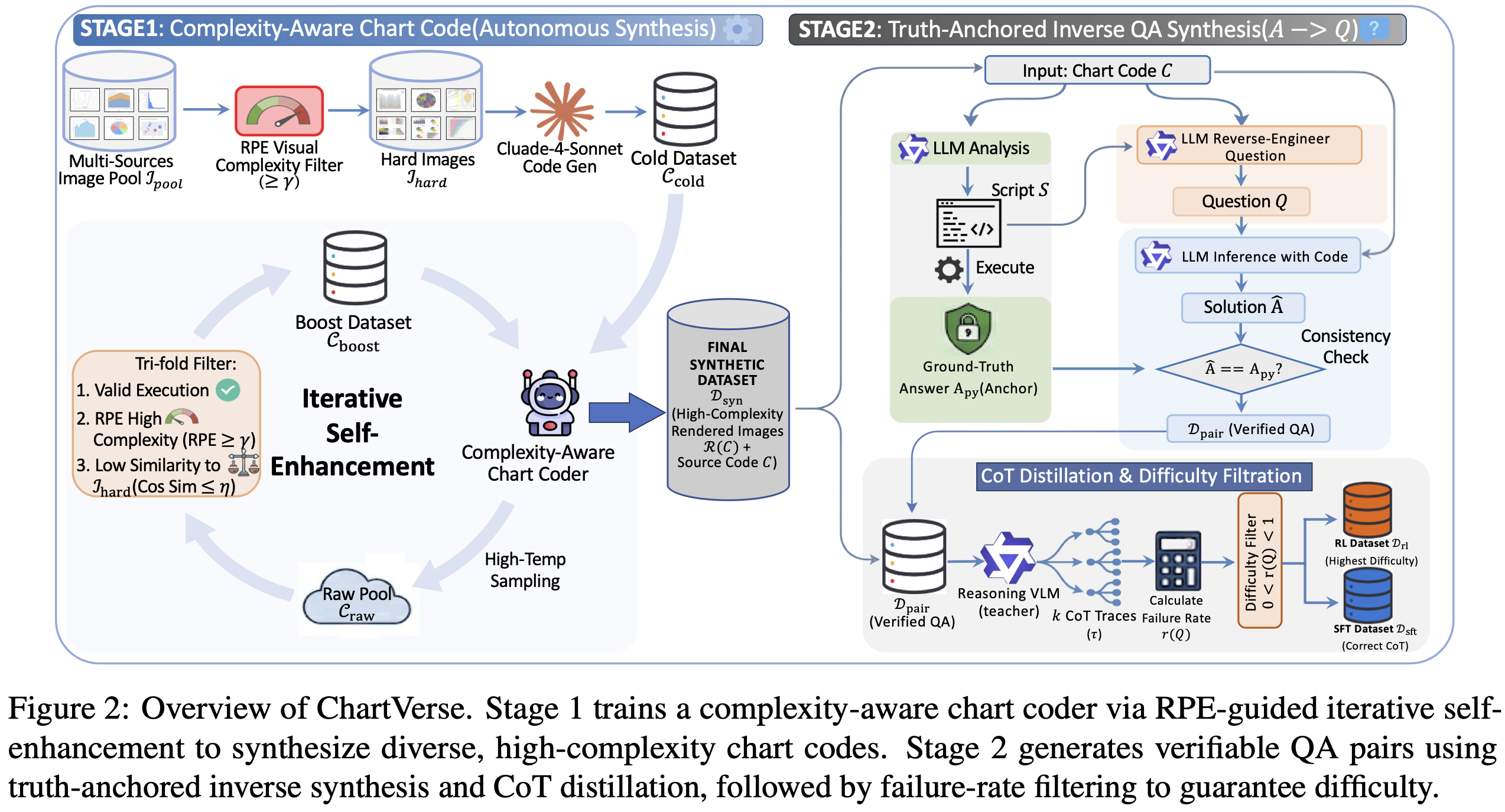
  • To guarantee reasoning rigor, we develop truth-anchored inverse QA synthesis. Diverging from standard generation, we adopt an answer-first paradigm: we extract deterministic answers directly from the source code, generate questions conditional on these anchors, and enforce strict consistency verification.

We curate ChartVerse-SFT-600K and ChartVerse-RL-40K using Qwen3-VL-30B-A3B-Thinking as the teacher. Experimental results demonstrate that ChartVerse-8B achieves state-of-the-art performance, notably surpassing its teacher and rivaling the stronger Qwen3-32B-Thinking.

Methodology

A two-stage framework combining complexity-aware chart synthesis with truth-anchored QA generation
Rollout Posterior Entropy
ChartVerse Pipeline
📊

1. Rollout Posterior Entropy

Given a chart, we prompt a VLM to generate executable code 8 times. Simple charts yield consistent codes, while complex ones lead to divergence. We compute spectral entropy from CLIP embeddings, retaining samples with RPE ≥ 0.4.

🔄

2. Complexity-Aware Coder

We train a specialized coder via iterative self-enhancement. Starting from a cold-start dataset filtered by high RPE, we repeatedly generate, filter by complexity and similarity, and retrain to produce diverse charts from scratch.

3. Truth-Anchored Inverse QA

We invert the generation flow: first extract deterministic answers from code execution, then reverse-engineer questions. A consistency check ensures logical soundness. Failure-rate filtering retains challenging samples.
Datasets & Comparison

ChartVerse-SFT-600K achieves superior diversity, complexity, and reliability

Dataset Chart Count Data Source Textual Data QA Count Total Tokens Answer Accuracy Reasoning Data Rollout Posterior Entropy ↑ Color Entropy ↑ Semantic Embedding Spread ↑
ChartQA 18K Real + Synthetic Table 28K 100K 0.26 2.03 0.37
PlotQA 156K Real + Synthetic Table 20M 117M 0.21 0.83 0.30
FigureQA 100K Synthetic - 1.3M 2.6M 0.25 1.04 0.24
ReachQA 3K Synthetic Code 20K 1.2M 0.29 1.91 0.47
ECD 10K Synthetic Code 321K 18.6M 0.31 2.13 0.40
CoSyn 116K Synthetic Code 1.1M 5.4M 0.35 1.73 0.54
START 400K Synthetic Code 400K 143M 0.33 1.63 0.27
ChartGen 216K Synthetic Code - - 0.30 1.31 0.39
ChartCoder 163K Synthetic Code - - 0.33 1.48 0.38
ChartVerse-SFT-600K (Ours) 412K Synthetic Code 603K 3.9B 0.44 3.17 0.51
Table 1: Comparison of ChartVerse-SFT-600K with existing chart datasets across chart properties, QA properties, and complexity/diversity metrics.

📈 Higher Complexity

Highest RPE score (0.44) compared to all baselines, indicating genuinely challenging visual structures.

🎨 Superior Diversity

Highest Color Entropy (3.17) and Semantic Embedding Spread, covering broad visual styles.

✓ Rigorous Reliability

Guaranteed answer accuracy via inverse QA pipeline with code-execution verification.

Performance

Data quality triumphs over model scale—smaller ChartVerse models outperform much larger baselines

📊 Main Results

Model ChartQA-Pro CharXiv (Reasoning) CharXiv (Descriptive) ChartMuseum ChartX EvoChart ChartBench (GPT-acc) Average
ECD-7B 45.1 41.7 74.9 24.5 59.3 56.0 48.6 50.0
START-7B 43.5 46.3 76.8 29.7 57.3 63.8 50.0 52.5
Chart-R1-7B 45.6 47.7 70.0 33.4 60.9 67.1 50.5 53.6
ChartVerse-2B 48.2 46.9 71.2 37.5 60.5 66.8 49.1 54.3
InternVL3.5-38B 47.8 45.5 86.5 34.2 55.5 65.0 49.0 54.8
InternVL3.5-241B-A28B 50.7 47.5 88.1 36.1 59.1 67.4 48.6 56.8
Qwen3-VL-8B-Thinking 53.9 53.0 85.9 44.3 59.6 74.1 49.1 60.0
ChartVerse-4B 55.2 56.2 84.1 45.9 63.7 75.0 52.9 61.9
Qwen3-VL-30B-A3B-Thinking 55.8 56.6 86.9 49.2 62.3 77.2 52.4 62.9
ChartVerse-8B 56.2 60.8 88.0 49.2 63.9 76.2 54.2 64.1
Qwen3-VL-32B-Thinking 58.8 65.2 90.2 55.9 64.1 80.8 54.3 67.0
Qwen3-VL-235B-A30B-Thinking 60.0 66.1 90.5 60.0 64.5 79.9 54.5 67.9
Table 2: Comparison of different models on 7 chart reasoning benchmarks. Shaded rows denote our ChartVerse models.

🔥 Small > Large

ChartVerse-4B (61.9%) outperforms Qwen3-VL-8B-Thinking (60.0%) with half the parameters.

🎓 Student > Teacher

ChartVerse-8B (64.1%) surpasses its teacher Qwen3-VL-30B-A3B-Thinking (62.9%).

🏆 Top-Tier Performance

Our 8B model rivals the much larger Qwen3-VL-32B-Thinking on chart reasoning benchmarks.

🔄 Training Stages Analysis

Model ChartQA-Pro CharXiv (Descriptive) CharXiv (Reasoning) ChartMuseum ChartX EvoChart ChartBench Chart Avg
Qwen3-VL-Instruct-2B 42.1 62.3 26.8 23.9 49.8 53.6 38.8 42.5
 + SFT 44.4 69.1 40.8 30.0 56.9 61.0 46.4 49.8
 + RL (ChartVerse-2B) 48.2 71.2 46.9 37.5 60.5 66.8 49.1 54.3
Qwen3-VL-Instruct-4B 53.7 76.2 39.7 37.2 57.2 68.2 45.1 53.9
 + SFT 52.9 84.5 52.8 42.5 61.9 73.3 50.3 59.7
 + RL (ChartVerse-4B) 55.2 84.1 56.2 45.9 63.7 75.0 52.9 61.9
Qwen3-VL-Instruct-8B 54.4 83.0 46.4 39.6 58.2 70.2 46.6 56.9
 + SFT 55.5 88.3 56.2 47.5 61.0 76.7 52.2 62.5
 + RL (ChartVerse-8B) 56.2 88.0 60.8 49.2 63.9 76.2 54.2 64.1
Table 3: Performance evolution across training stages. SFT establishes strong foundations; RL further enhances performance on challenging samples.

🧪 Generalization to STEM Tasks

The reasoning skills acquired from ChartVerse data transfer effectively to out-of-domain STEM reasoning tasks, demonstrating the general value of our high-quality chart reasoning data.

Model MathVista DynaMath MathVerse LogicVista VisuLogic STEM Avg
Qwen3-VL-Instruct-2B 61.3 52.1 54.2 35.8 11.5 43.0
 + SFT 58.7 47.6 55.8 43.2 17.5 44.6
 + RL (ChartVerse-2B) 60.4 49.2 56.8 48.5 23.1 47.6
Qwen3-VL-Instruct-4B 73.7 46.8 65.3 53.2 19.0 51.6
 + SFT 70.9 60.7 71.1 57.3 25.0 57.0
 + RL (ChartVerse-4B) 72.8 62.0 71.8 59.3 27.0 58.6
Qwen3-VL-Instruct-8B 77.2 62.1 67.7 55.3 22.5 56.7
 + SFT 75.0 67.4 75.6 61.3 26.5 61.2
 + RL (ChartVerse-8B) 75.6 69.0 76.5 62.6 27.1 62.2
Table 4: Performance on STEM-related benchmarks. ChartVerse-8B improves from 56.7 to 62.2 (+5.5%), demonstrating strong transfer to mathematical and logical reasoning tasks.

Reasoning Examples

Complex questions with rigorous Chain-of-Thought reasoning

Chart
Question

Answer

Code Solution
Chain of Thought

Citation

@article{chartverse2026,
  title={ChartVerse: Scaling Chart Reasoning via Reliable 
         Programmatic Synthesis from Scratch},
  author={Anonymous Authors},
  journal={Anonymous ACL Submission},
  year={2026}
}